
Financial Fraud Detection System with Real-Time AI Scoring
A fintech or financial services buyer comparing fraud detection software and custom fintech app development partners.
Buyer context
The business problem was measurable before the first model call
Why it mattered
False negatives created direct loss, while false positives created customer friction and operations cost. Both sides of the model mattered.
The buyer needed low-latency risk scoring, explainable review queues, false-positive control, and production infrastructure that could operate inside financial constraints.
Product walkthrough
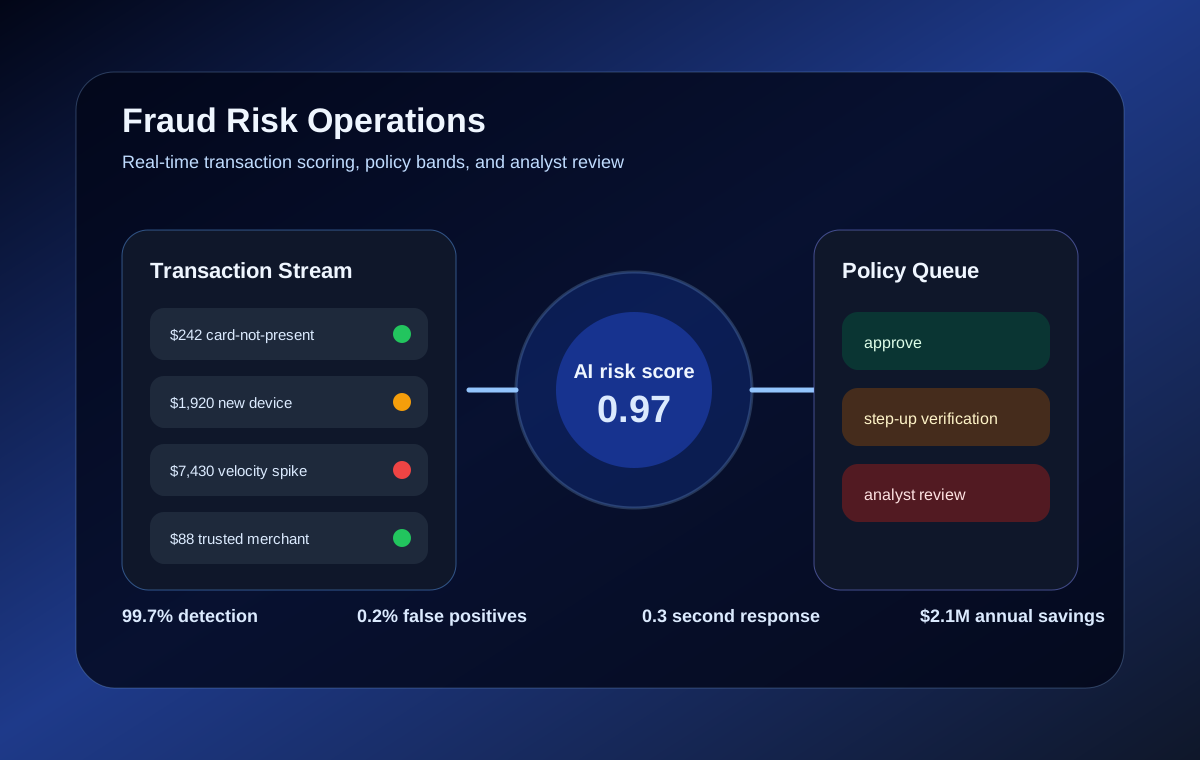
Fraud AI is a policy system wrapped around fast model scoring
Score
Transaction risk in 0.3 seconds
Band
Policy action by risk threshold
Review
Analyst queue for risky cases
Learn
Monitor drift and update patterns
Risk band table
Architecture
The useful part is the system around the model
Real-time scoring
The scoring path had to stay fast enough for live financial transactions.
Policy separation
Risk scores and business actions stayed separate so thresholds could be governed.
Analyst review queue
High-risk cases moved into a review workflow with context and reason codes.
Drift monitoring
Fraud behavior changes, so the system needed ongoing monitoring and retraining paths.
Technical implementation
Deep learning models for transaction analysis, real-time streaming with Apache Kafka, automated model retraining, and comprehensive fraud pattern detection.
Before / after
The page has to teach the decision, not just announce the win
Before
The financial services team was losing money due to fraud detection gaps. Their manual system missed 23% of fraudulent transactions and had 8% false positives.
Build
We developed a real-time AI fraud detection system using machine learning models trained on historical transaction data, with continuous learning and adaptation.
After
Fraud detection accuracy improved from 77% to 99.7%, false positives dropped from 8% to 0.2%, and the system now responds in 0.3 seconds, saving $2.1M annually.
How we would build it today
A buyer can use this as a practical project brief
Define risk actions before modeling: flag, hold, step-up verification, or block.
Separate model scoring from policy decisions so risk teams can tune thresholds.
Add model monitoring for drift, false positives, and emerging attack patterns.
Build analyst tools that explain why transactions were flagged.
Buyer checklist
Decision framework
When this kind of build is the right move
Custom build when
Fraud patterns, products, or approval policies are specific to your business.
Buy first when
You need commodity coverage quickly and can accept vendor-defined workflows.
Measure success by
Fraud caught, false positives, review load, latency, and customer impact.
Caveats
Fraud patterns drift, so monitoring and retraining are part of the product.
The system needed review queues and governance, not just automated blocking.
The accuracy metric applies to the measured transaction-risk workflow and data distribution.
Next steps
If this looks like your problem, start with the closest intent path
What should a fintech team look for before starting this kind of AI project?
Start with a measurable workflow, clean access to the relevant data, a clear escalation or review path, and agreement on the success metric. TensorBlue uses those inputs to decide whether fraud detection software should be a prototype, a production workflow, or a phased rollout.
How much of the result came from AI versus product engineering?
The AI model was only one layer. The outcome came from data preparation, workflow design, product UX, integration, monitoring, and adoption planning around the model. That is why the case study focuses on the full system, not only the model choice.
Can this be rebuilt for a different company without copying the same implementation?
Yes, but the workflow, integrations, controls, and measurement plan need to be redesigned around the new business. The reusable part is the delivery pattern; the exact implementation should stay specific to the buyer's data, users, and operational constraints.
What is the main caveat behind the published result?
The result depends on historical transaction data quality, labeled fraud examples, and continuing monitoring for fraud-pattern drift.