Manufacturing Quality Control AI with Computer Vision Inspection
A manufacturing operator looking for computer vision development or quality inspection AI to reduce rework and defects.
Buyer context
The business problem was measurable before the first model call
Why it mattered
Every missed defect became expensive rework or recall risk, while slow inspection could constrain throughput. The system had to improve quality without slowing production.
The buyer needed machine-vision accuracy, plant-floor latency, edge deployment, defect taxonomy, and operator trust in the inspection process.
Product walkthrough
Machine vision quality work starts on the production line, not in a notebook
Inspection cell
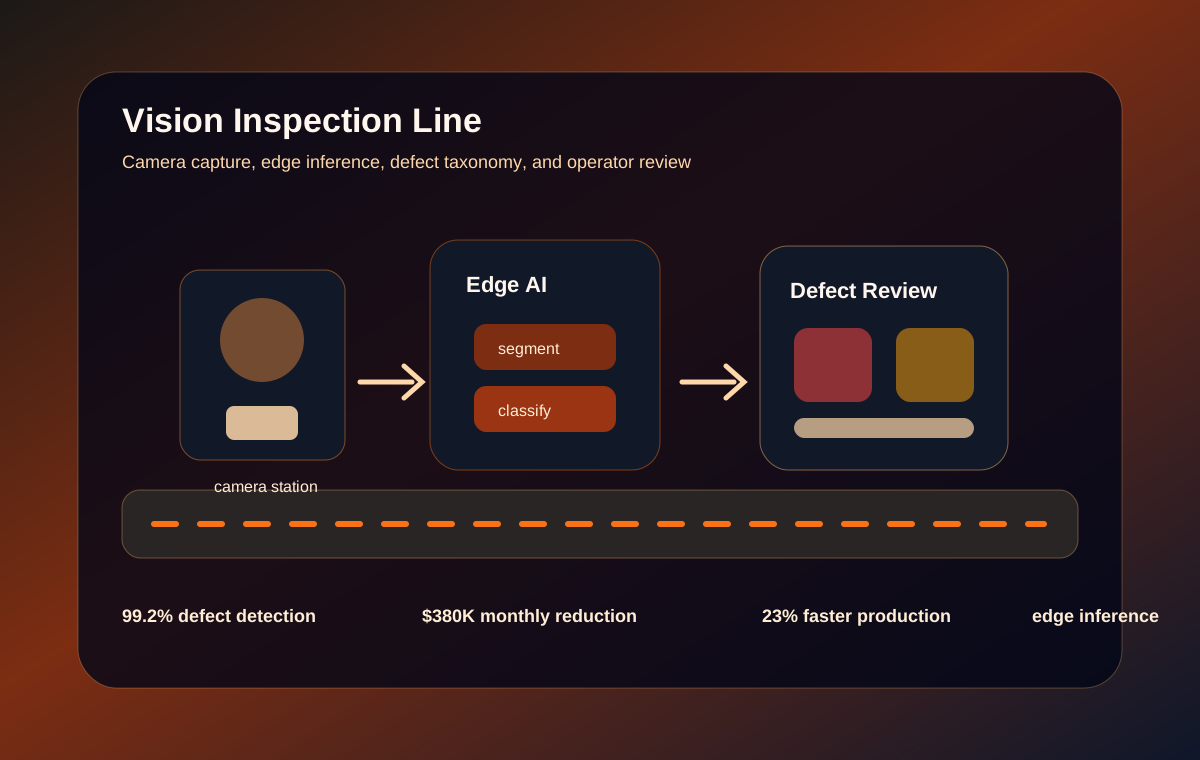
The product has to control lighting, capture, inference, operator override, and retraining feedback.
Image capture
Stable lighting and camera position
Defect taxonomy
Classes defined by production reality
Edge inference
Low-latency inspection near the line
QA dashboard
Review defects and retrain examples
Architecture
The useful part is the system around the model
Capture design
Camera placement and lighting made the model input reliable enough for inspection.
Defect taxonomy
The model and QA dashboard were organized around concrete defect classes.
Edge deployment
Inference ran close to the production line to meet latency and reliability requirements.
Operator feedback
Overrides and reviews created new training examples for continuous improvement.
Technical implementation
Computer vision models for defect detection, edge computing deployment for real-time processing, IoT sensor integration, and automated quality reporting dashboard.
Before / after
The page has to teach the decision, not just announce the win
Before
The manufacturer was losing $450K monthly due to quality control defects that were not caught until after production, requiring expensive recalls and rework.
Build
We implemented a computer vision AI system that inspects products in real time during production, detecting defects with 99.2% accuracy and preventing defective products from reaching customers.
After
Defect detection improved from 87% to 99.2%, monthly costs dropped by $380K, production speed increased by 23%, and overall quality score rose from 91% to 98.7%.
How we would build it today
A buyer can use this as a practical project brief
Begin with defect taxonomy, image capture design, and line-speed constraints.
Validate model performance by defect type, not only aggregate accuracy.
Use edge inference when latency, reliability, or data residency require it.
Give operators a review UI so they can confirm, override, and improve labels.
Buyer checklist
Decision framework
When this kind of build is the right move
Use computer vision when
Defects are visible, repeatable, and expensive enough to justify automated inspection.
Use process control first when
Defects are caused by unstable upstream process parameters that can be directly controlled.
Measure success by
Detection by defect class, false rejects, throughput, rework cost, and quality score.
Caveats
Lighting, camera placement, and defect taxonomy were as important as model architecture.
Edge deployment was needed because plant-floor latency mattered.
The result applies to defined defect categories in the inspected production environment.
Next steps
If this looks like your problem, start with the closest intent path
What should a manufacturing team look for before starting this kind of AI project?
Start with a measurable workflow, clean access to the relevant data, a clear escalation or review path, and agreement on the success metric. TensorBlue uses those inputs to decide whether computer vision quality inspection should be a prototype, a production workflow, or a phased rollout.
How much of the result came from AI versus product engineering?
The AI model was only one layer. The outcome came from data preparation, workflow design, product UX, integration, monitoring, and adoption planning around the model. That is why the case study focuses on the full system, not only the model choice.
Can this be rebuilt for a different company without copying the same implementation?
Yes, but the workflow, integrations, controls, and measurement plan need to be redesigned around the new business. The reusable part is the delivery pattern; the exact implementation should stay specific to the buyer's data, users, and operational constraints.
What is the main caveat behind the published result?
The result assumes stable image capture, a defined defect taxonomy, and validation against real production-line examples.