
Designing a self-improving agent system for content, growth, and product actions
TensorBlue designed an agent architecture that continuously observes signals, analyzes opportunities, predicts the best next actions, executes with guardrails, measures outcomes, learns from feedback, and evolves its capabilities.
Proof note: This is a TensorBlue internal operating-system case study. The visuals are conceptual explainers, not client screenshots.
Seed Actions
Bootstrap knowledge
Input
Collect signals
Analysis
Find opportunities
Action Space
Available capabilities
Prediction
Choose best action
Execution
Act with guardrails
Measurement
Measure outcomes
Feedback
Learn and store memory
Evolution
Expand capabilities
Human approval gate
High-risk actions go through approval before execution.
Attribution & measurement
Isolate impact and measure what matters.
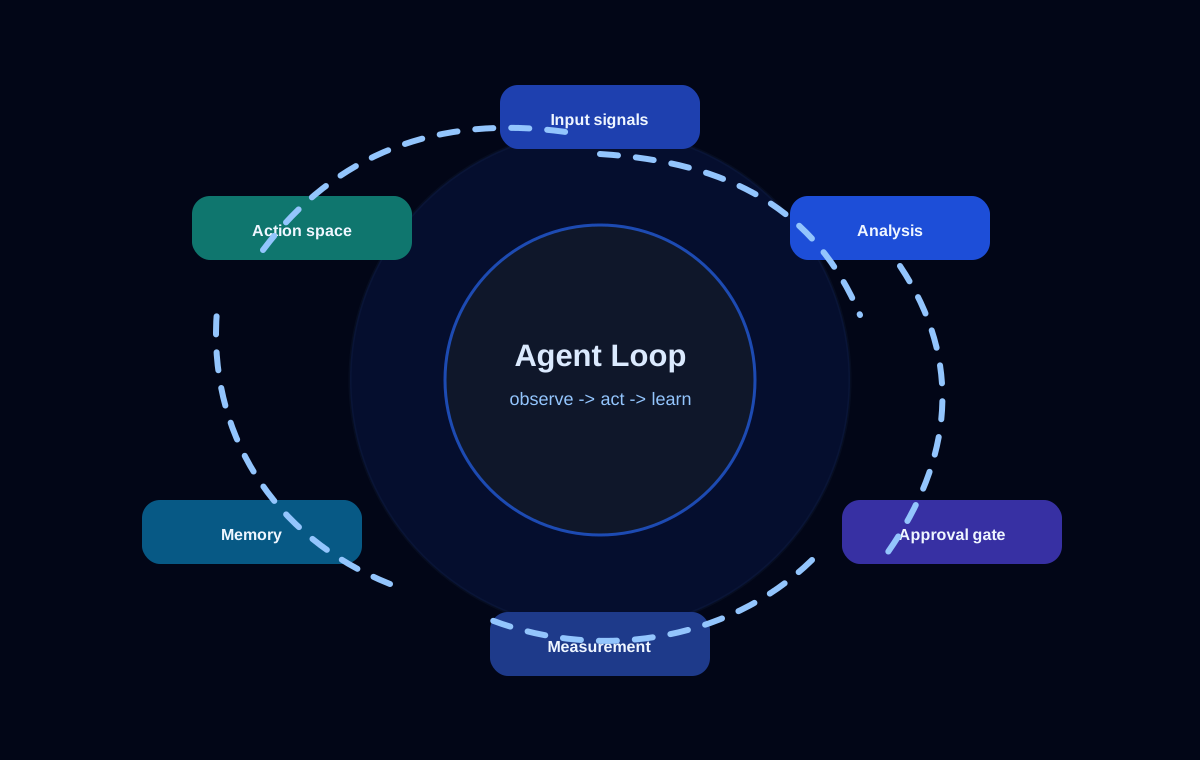
An agent loop built for observation, action, and learning
TensorBlue's agent framework structures decision-making into a clarity loop. Each layer has a distinct responsibility and depends on the one before it, creating a repeatable path from raw signals to measurable impact.
The 8 Core Loop Layers
Extended System: Evolution & Capability Growth
These layers evolve the agent over time, expanding what it can do and how effectively it learns.
Seed Actions
Bootstrap knowledge with curated actions.
Action Generation
Generate candidates from feedback and experience.
Action Space Evolution
Expand capabilities when new actions require tools.
Safety / approval gate
High-risk actions go through human approval in the control room.
Attribution discipline
Attribute impact to the action that caused it, not the ones that ran in the same window.
Important: Action Space means the things the agent can change about the task, such as timing, budget, message, audience, channel, sequence, and bids.
How actions move from signal to safe execution
The system observes inputs across your content engine, proposes the best next actions, routes risky decisions through human approval, executes safely at scale, and logs every outcome to continuously improve.
Observe
Continuously collect signals and context.
Analyze
Find patterns and surface opportunities.
Propose
Generate action options with expected impact.
Approve
Human-in-the-loop checkpoint.
Execute
Run actions safely with guardrails.
Learn
Capture outcomes and improve the system.
Control Room
Monitor, approve, and override actions with visibility.
Pending approvals
Memory & Attribution
Store every decision and outcome for accountability.
Action Space
Variables the agent can change to find what works.
Why a smarter agent system was needed
As content, growth channels, and products scaled, disconnected automations, slow learning cycles, and manual decision-making created bottlenecks that limited impact and innovation.
Disconnected automations
Separate tools with no shared learning.
Slow feedback loops
Teams wait too long to know what works.
Limited action space
Systems can do tasks but not optimize outcomes.
High-risk execution
Sensitive actions need human oversight.
What the new system had to deliver
Manual Ops
Learning System
Where this architecture can expand
Once the fast-feedback loop is proven, the same framework can be extended to retention, email, metrics, community, SEO, and new product workflows.
AI News Agent
Find, curate, and publish AI news that drives traffic and engagement.
Fast loopAI Blogs Agent
Plan, write, and optimize blog posts for growth and search visibility.
Medium loopAI Case Study Agent
Turn results into case studies that build trust and conversions.
Medium loopEmail Newsletter Agent
Create, personalize, and send newsletters that drive opens and clicks.
Fast loopRe-engagement Agent
Identify inactive users and re-engage them with relevant offers.
Fast loopChurn Prediction Agent
Predict churn risk and trigger retention actions before it happens.
Slow loopCommunity Agents
Monitor, engage, and activate community members at scale.
Slow loopSEO Optimization Agents
Scale content production and optimize rankings, discovery, and visibility.
Medium loopAssess goals, data, and systems to map agent opportunities.
Define agent roles, loops, signals, and guardrails.
Implement agents, integrate data and tools, and validate loops.
Monitor performance, refine prompts and logic, and scale impact.
Want TensorBlue to design your AI agent system?
We will turn this framework into a tailored agent ecosystem that learns, adapts, and drives real outcomes.
From experiments to measurable outcomes
Fast-feedback loops let TensorBlue validate hypotheses quickly, learn from action outcomes, and scale what works.
Higher re-engagement
Users came back more often through next-day feedback loops.
Faster iteration
Changes shipped and validated nearly twice as fast.
Safer execution
Human approval and guardrails reduced incidents.
Reusable agent patterns
Architecture accelerated delivery across new use cases.
Learning over time
Cumulative lift in desired outcomes
Action performance
Success rate by action type