
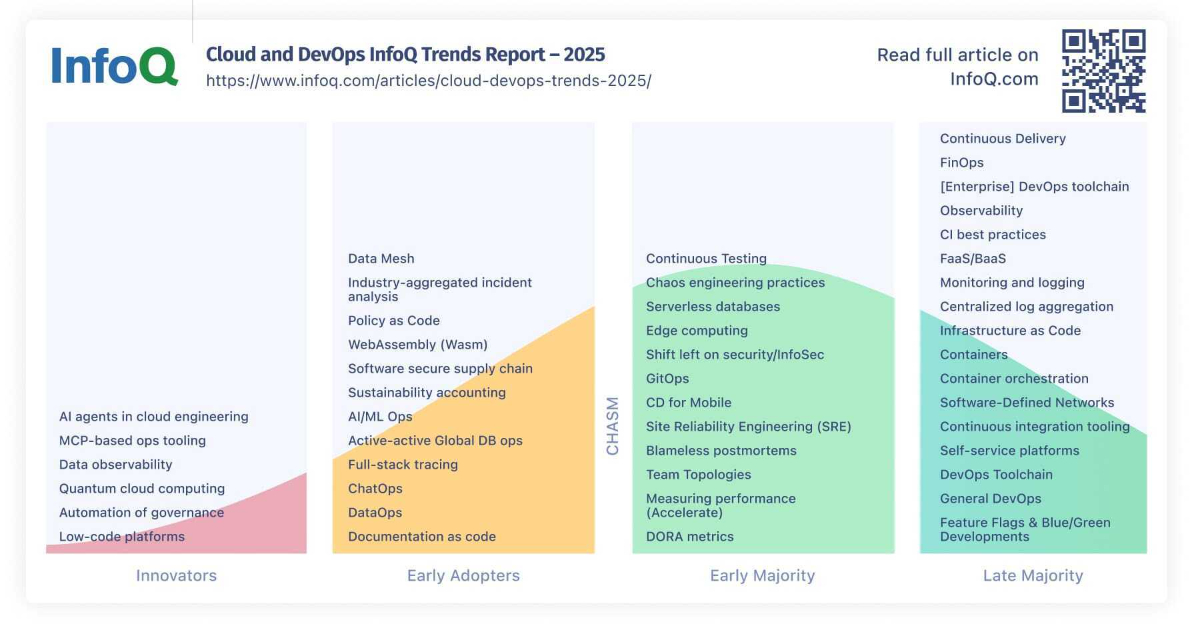
Cloud Devops Trends 2025
InfoQ editorial staff and friends of InfoQ are discussing the current trends in the domain of Cloud and DevOps as part of the process of creating our annual trends report.
/filters:no_upscale()/articles/cloud-devops-trends-2025/en/resources/1Infoq-cloud-devops-trends-2025-1760961887459.jpg)
InfoQ editorial staff and friends of InfoQ are discussing the current trends in the domain of Cloud and DevOps as part of the process of creating our annual trends report. This TensorBlue analysis is based on reporting and source material from InfoQ (https://www.infoq.com/articles/cloud-devops-trends-2025/).
What Happened
InfoQ Homepage Articles InfoQ Cloud and DevOps Trends Report - 2025
InfoQ Cloud and DevOps Trends Report - 2025
The rise of AI Agents for cloud engineering shows a lot of promise. However, enterprise adoption is slowed by compliance, security, and the need for human governance alongside legacy systems.
Platform Engineering is a boardroom priority driven by developer experience (and ultimately, productivity). Yet, success is often limited by organizational tool fragmentation and a lack of foundational Value Stream Management.
FinOps has matured beyond budgeting to focus intensely on cost optimization and strategic consolidation, driven by global pressure to "do more with less" and the high compute costs of AI initiatives.
The influx of new tools and AI mandates is currently increasing cognitive load across all roles, not reducing it. Leaders must prioritize consolidation and measure value beyond "vanity metrics".
Kubernetes is now the stable, de facto substrate for cloud-native deployment. The stability of the Kubernetes API supports the practical reality of hybrid and multi-cloud strategies, which are in turn driven by the underlying need for resilience and digital sovereignty.
The InfoQ Trends Reports offer InfoQ readers a concise, opinionated overview of topics that we believe architects and technical leaders should prioritize. In addition to this report and the update
I think, of course, the infusion of AI is predominantly in a lot of cloud services. Not sure they're always helpful, but you definitely see an uptick of AI going from what is the first wave, now all the way to agentic, where you also see agents popping up in some of the, I would say, cloud services as well.
InfoQ
This topic matters because it signals where AI product delivery, engineering execution, and technical strategy are moving next.
Implications for Product and Engineering Teams
For TensorBlue readers, the useful question is not just what happened, but how this changes product architecture, engineering priorities, AI delivery, observability, team workflows, or executive decision-making.
- Review whether this changes your AI roadmap, platform architecture, or engineering operating model.
- Identify the specific workflow, reliability, governance, or developer-productivity lesson that applies to your organization.
- Convert the lesson into a small production experiment with measurable quality, latency, cost, adoption, or risk metrics.
- Document source assumptions clearly so teams do not overgeneralize from incomplete public information.
TensorBlue Takeaway
The practical opportunity is to turn this signal into a concrete implementation decision: better AI systems, stronger product instrumentation, more reliable automation, and clearer technical governance. Teams that connect public technology shifts to their own delivery systems will move faster without adding unnecessary complexity.
TensorBlue AI Desk
AI systems, software engineering, and product strategy