
Custom ML Models
Solutions designed for your data and industry.
Turn your data into measurable outcomes. We design, train
and deploy machine learning models tailored to your business
goals.
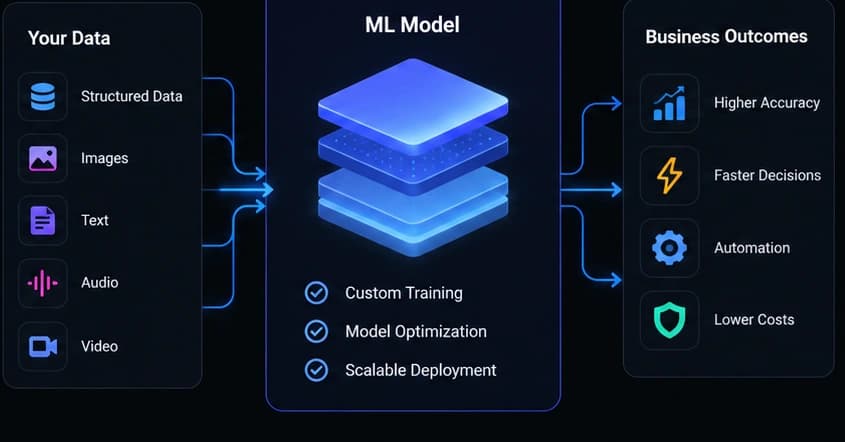
Solutions designed for your data and industry.
Uncover trends and make data-driven decisions.
From data preparation to deployment and monitoring.
Production-ready models with enterprise-grade security.
Practical AI solutions across predictive modeling, automation, analytics, and intelligent decision systems.
Forecast behavior and outcomes using historical and real-time business data.
Build supervised learning pipelines for scoring, categorization, and estimation.
Predict demand, inventory, sales, and operational resource needs.
Personalize products, content, and experiences using ranking models.
Identify unusual transactions, equipment signals, and operational exceptions.
Tune features, evaluate models, and improve performance at inference time.
Use-case driven model development designed around industry data, workflows, and measurable outcomes.
Demand forecasting, customer segmentation, product recommendations.
Fraud detection, risk scoring, transaction anomaly detection.
Operational forecasting, document classification, clinical workflow support.
Predictive maintenance, process optimization, quality analytics.
Route forecasting, capacity planning, delivery-delay prediction.
Churn prediction, customer insights, intelligent product analytics.
A structured end-to-end workflow focused on quality, reproducibility, and business value.
Define the business problem, success metrics, and available data.
Clean datasets, label samples, and prevent training/test leakage.
Train candidate models and iterate on features and architecture.
Evaluate accuracy, robustness, fairness, and failure cases.
Integrate APIs, batch jobs, or real-time inference into products.
AFTER LAUNCH · Monitor drift · Retrain when needed · Review performance against business KPIs
Select the right framework, infrastructure, and MLOps workflow for each use case rather than forcing a single stack.
Build confidence through monitoring, traceability, human review, and secure deployment practices.
Track drift, prediction quality, latency, and changing input distributions.
Test edge cases and bias alongside standard accuracy metrics.
Use access controls and well-scoped services to protect business data.
Escalate uncertain predictions and critical decisions to reviewers.
DELIVERABLES · Model artifacts · Evaluation report · Integration documentation · Monitoring and handover plan
Common considerations before investing in a custom ML solution.
Not always. Data requirements depend on the task, model, label quality, and available pretrained models.
Yes. ML capabilities can connect via APIs, background jobs, existing databases, and internal business applications.
Define task-specific metrics and compare them with current business processes before launch.
Track data drift and quality, monitor failures, and retrain or revise the model as needed.