
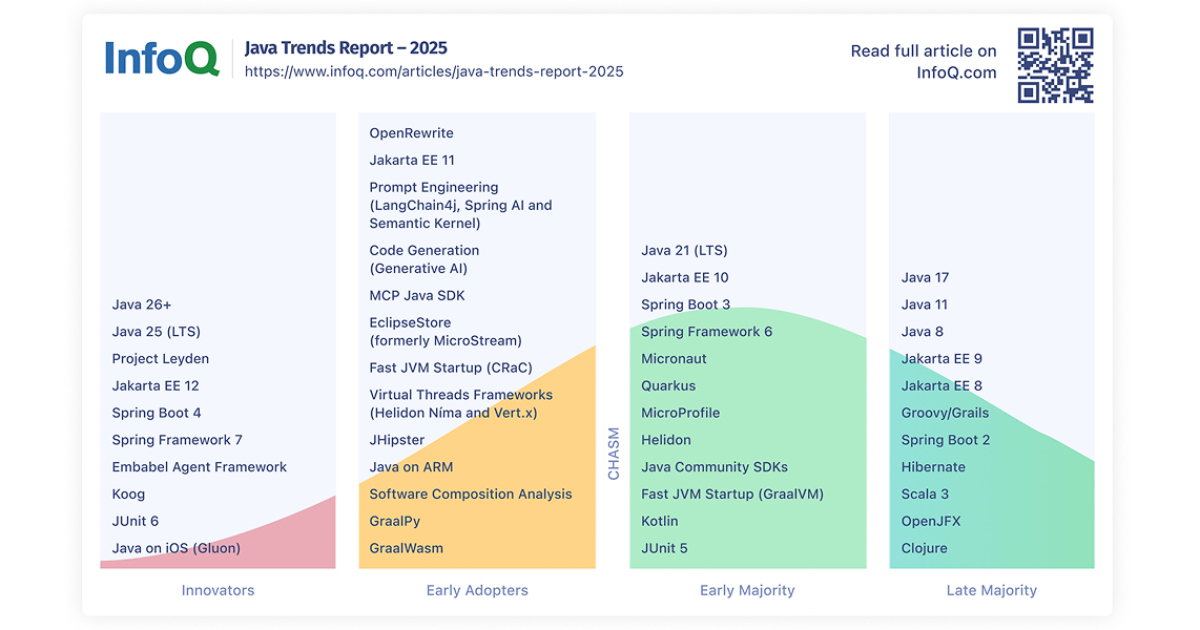
Historical source and scope
InfoQ’s 2025 Java report discusses Java 25, JVM AI frameworks, legacy modernization, Jakarta EE and changing deployment choices. Its examples include Spring AI and LangChain4j. Framework visibility in a trends report is a reason to investigate, not evidence that it fits a particular application.
Read the original InfoQ report for the source authors’ full discussion. The following implementation review is TensorBlue’s analysis, revised in October 2026; it is not a reproduction of that report.
Define the modernization problem before the target
Identify the present constraint: unsupported dependencies, difficult releases, operational risk or a missing application capability. Separate the runtime upgrade from an architecture redesign so each has its own acceptance evidence. A service can need a supported runtime without needing a wholesale rewrite. Keep the operating owner involved in choosing the first bounded change.
Evaluate JVM AI frameworks through application contracts
For a proposed model integration, compare authentication, streaming, tool invocation, structured outputs and failure handling against the actual product needs. Test cancellation and provider errors as well as a successful answer. Keep business rules and permissions in reviewable application code rather than relying on a generated response to enforce them.
Use automated refactoring as a proposed patch
A transformation tool can reduce repetitive edits, but generated changes still need compatibility and behavioral checks. Review the recipe, affected APIs and assumptions. Apply it to a limited module first, inspect the diff and run relevant tests. Maintain an evidence trail from the chosen transformation to the resulting behavior instead of equating a completed tool run with a completed migration.
Distinguish a platform specification from your deployment
For a Jakarta EE change, map the required APIs to the application server and dependency versions in use. Verify the target combination with the application’s integration tests and operating constraints. A specification milestone does not mean every library, vendor implementation or existing application is ready to move at the same time.
Choose placement from data and operations
Compare public cloud, regional hosting and on-premise options using data flows, connectivity, support ownership and recovery requirements. Include backups, telemetry and model-provider calls in the diagram. Moving the JVM service on-premise does not establish that all connected application data remains there. Document the complete path before making that claim.
Make the release decision from evidence
A modernization review should show compatibility results, known regressions, workload measurements, dependency support and rollback feasibility. Add a limited rollout with named owners and observable criteria. These are our recommended review steps, not measured TensorBlue outcomes. Compare with the 2024 review for the earlier migration and dependency questions that remain relevant.
Compare the other annual review, explore our technology selection guide, or discuss a scoped implementation.