Composite implementation case study
Visual Quality Inspection with Operator Feedback
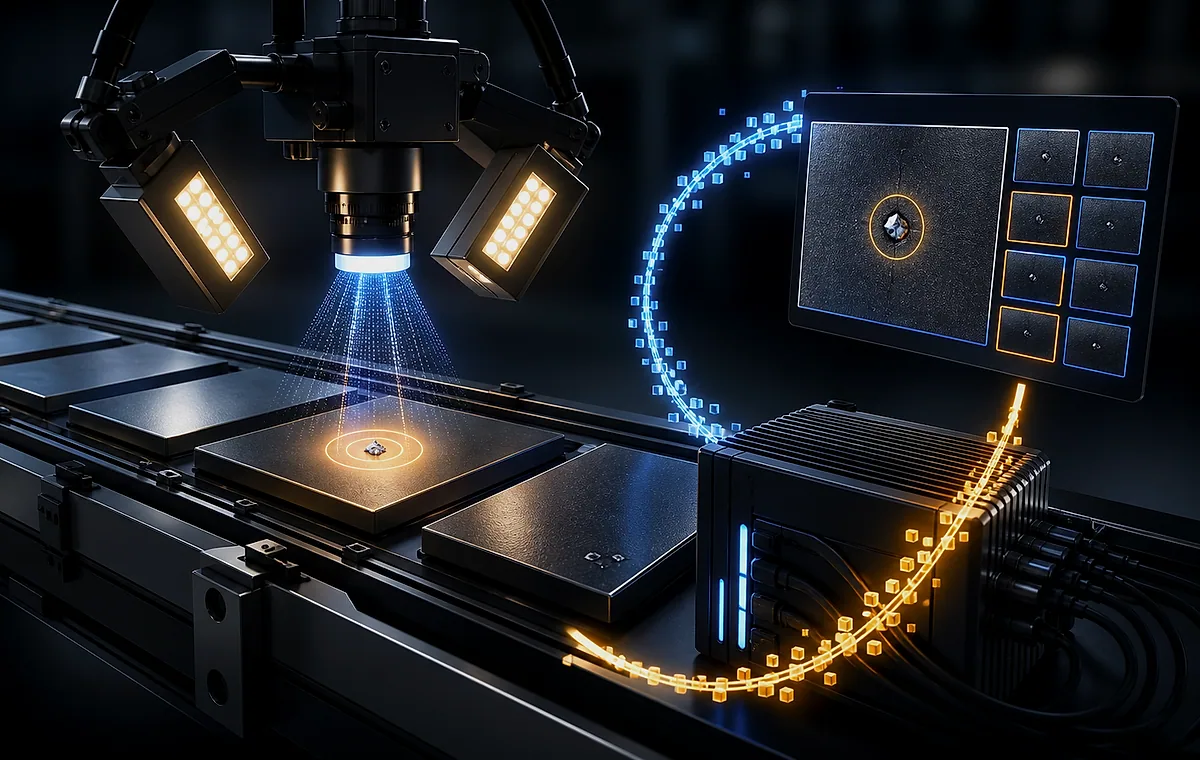
This reference case study turns image capture, defect classification, and exception review into a production-ready machine learning brief for line operators and quality engineers. It shows how product design, system architecture, delivery, measurement, and governance can work together to reduce escaped defects without excessive false rejects.
This is a transparent composite reference blueprint, not a fabricated client win. The metrics below are measurement frameworks and release gates to validate against a real baseline.
01 / Executive brief
A product decision, not a technology demo
Line operators and quality engineers need a clearer way to complete image capture, defect classification, and exception review; fragmented tools and ambiguous handoffs make the current journey slow, hard to measure, and difficult to govern.
A focused machine learning system that supports image capture, defect classification, and exception review, makes exceptions visible, and creates a measurable path to reduce escaped defects without excessive false rejects.
Reduce escaped defects without excessive false rejects matters only if the product also handles lighting, defect taxonomy, and edge latency. Optimizing the happy path while ignoring those constraints would move cost and risk elsewhere in the operation.
north Star
Reduce escaped defects without excessive false rejectsNorth-star outcomequality Gate
Performance by segment and thresholdRelease gateoperating Mode
Measured prediction workflowDesigned operating stateevidence
Baseline → pilot → productionEvidence path02 / Experience design
Design the complete job, including uncertainty and recovery
- 01
Orient
Show the user where they are in image capture, defect classification, and exception review, what is required, and what the system can and cannot do.
- 02
Capture
Collect only the information needed for the next decision, with progressive disclosure and clear validation.
- 03
Decide
Combine rules, data, and Computer Vision into a reviewable recommendation or system state.
- 04
Act
Execute the permitted action, ask for approval when needed, and keep the user informed about progress.
- 05
Learn
Measure whether the journey helped reduce escaped defects without excessive false rejects; route errors and overrides into product improvement.
A manufacturing product or technology leader researching how to scope, design, and de-risk visual quality inspection with operator feedback.
Help line operators and quality engineers understand the next best action without hiding important uncertainty.
Preserve the evidence and context behind every consequential state change.
Make exceptions recoverable so the team can learn instead of creating a silent failure queue.
03 / System architecture
Separate experience, decisions, integrations, and operations
Experience layer
Role-aware interfaces for line operators and quality engineers, including empty, loading, uncertain, and recovery states.
Workflow layer
Explicit states, ownership, approvals, timeouts, and exception paths for image capture, defect classification, and exception review.
Decision layer
Computer Vision, deterministic rules, confidence handling, and a safe fallback path.
Data + context layer
Permission-aware inputs with freshness, lineage, validation, and retention rules.
Integration layer
Idempotent connectors to systems of record, notifications, identity, and operational tools.
Operations layer
Task traces, quality sampling, cost and latency budgets, incident support, and improvement queues.
Choose components after the workflow and evaluation plan are clear.
- Python
- Feature Pipelines
- Model Registry
- Batch + Streaming
- Monitoring
- Decision UI
- Computer Vision
04 / Delivery plan
Move from observed workflow to controlled production release
1–2 weeks
Baseline the job
1–2 weeks
Prototype the risky moment
3–6 weeks
Build one complete slice
2–4 weeks
Pilot with controls
Ongoing
Scale what proved useful
Buyer readiness checklist
- A named owner for “reduce escaped defects without excessive false rejects” and a reliable baseline
- Representative users from line operators and quality engineers
- Access to the systems, data, and policies involved in image capture, defect classification, and exception review
- Acceptance criteria for lighting, defect taxonomy, and edge latency
- A pilot cohort, release gate, and post-launch operating owner
Practical build principles
- 1Start with the smallest end-to-end version of image capture, defect classification, and exception review that can produce a measurable outcome.
- 2Make lighting, defect taxonomy, and edge latency visible in user stories, system boundaries, and acceptance criteria.
- 3Instrument the journey around “reduce escaped defects without excessive false rejects” before scaling scope or automation.
- 4Ship with explicit failure, approval, override, and support paths instead of relying on a perfect happy path.
05 / Measurement and testing
Prove the task works before claiming transformation
Proves that the product changes the business or user result.
Prevents a fast workflow from becoming an unreliable one.
Separates product value from availability alone.
Shows where automation creates hidden work or risk.
Five checks before expanding scope
- 01Define the decision and baseline before selecting a model
- 02Split evaluation by cohort, geography, and edge condition
- 03Back-test leakage, calibration, and threshold sensitivity
- 04Shadow-run predictions before automating decisions
- 05Monitor drift, override behavior, and business impact after launch
06 / Risks and decisions
The failure modes belong in the design brief
Automating an unclear process
Mitigation: Stabilize ownership, states, and decision policy before adding more automation.
lighting, defect taxonomy, and edge latency
Mitigation: Turn the constraint into acceptance criteria, test cases, permissions, and monitored release gates.
Optimizing a proxy metric
Mitigation: Tie local metrics back to “reduce escaped defects without excessive false rejects” and review unintended effects by segment.
No recovery path
Mitigation: Design retries, undo, escalation, reconciliation, and human support as first-class product states.
The team can measure reduce escaped defects without excessive false rejects, access representative inputs, and support a bounded pilot.
The risky assumption is user trust, decision quality, or lighting, defect taxonomy, and edge latency.
Ownership, policy, and source-of-truth data are too ambiguous to encode safely.
07 / Search research coverage
Related buyer questions covered by this blueprint
25 mapped search topics View research terms
- healthcare software development companiesC · Vol. 1.3K
- mvp software development companyC · Vol. 720
- ecommerce mobile app development companyI · Vol. 480
- swift app development servicesI · Vol. 390
- android app development costI · Vol. 260
- flutter app development company usaI · Vol. 170
- fort worth ios app development companyI, C · Vol. 110
- hire ethereum software developerC · Vol. 90
- custom flutter app development companyI · Vol. 70
- custom banking software development companyI · Vol. 50
- top mobile app development company in uaeC · Vol. 50
- enterprise mobile app development processUnclassified · Vol. 40
- mvp product development companyUnclassified · Vol. 30
- top mobile app development companies in ukUnclassified · Vol. 30
- mvp development company charlestonUnclassified · Vol. 20
- leader in cross-platform wearable app development companyUnclassified · Vol. 20
- best software development outsourcing companiesUnclassified · Vol. 20
- custom application development services seattleUnclassified · Vol. 10
- mvp development services for tech companiesUnclassified · Vol. 10
- mobile app development companies in flutterUnclassified · Vol. 10
- hire dating mobile app developersUnclassified · Vol. 10
- best companies to outsource software development 2025 2026Unclassified · Vol. 10
- biggest custom application development serviceUnclassified · Vol. 0
- agile mobile app developer for startups & enterprisesUnclassified · Vol. 0
- malaysia custom software development cost range 2025Unclassified · Vol. 0
08 / Frequently asked questions
Questions to answer before approving the build
What should a manufacturing team validate before building visual quality inspection with operator feedback?
Validate the real baseline for image capture, defect classification, and exception review, confirm that line operators and quality engineers agree on the decision and handoff states, and turn “reduce escaped defects without excessive false rejects” into a metric with a named owner. The blueprint treats lighting, defect taxonomy, and edge latency as a design input, not a late compliance checklist.
Is this a real client result or a reference implementation?
This is a transparent composite implementation blueprint. It combines recurring product, design, data, and engineering patterns into a practical reference; all KPI values are measurement targets to validate, not claimed client outcomes.
How long would a production machine learning build take?
A focused first production release commonly starts in the 12–20 weeks range, but integrations, data readiness, regulated review, migration, and the number of roles can change the scope materially. Discovery should produce a phased estimate rather than force a generic fixed promise.
What makes the blueprint useful to a product team?
It connects the user journey to the architecture, delivery phases, evaluation plan, operating controls, risk mitigations, and post-launch metrics so design and engineering can work from one shared brief.