
Historical source and scope
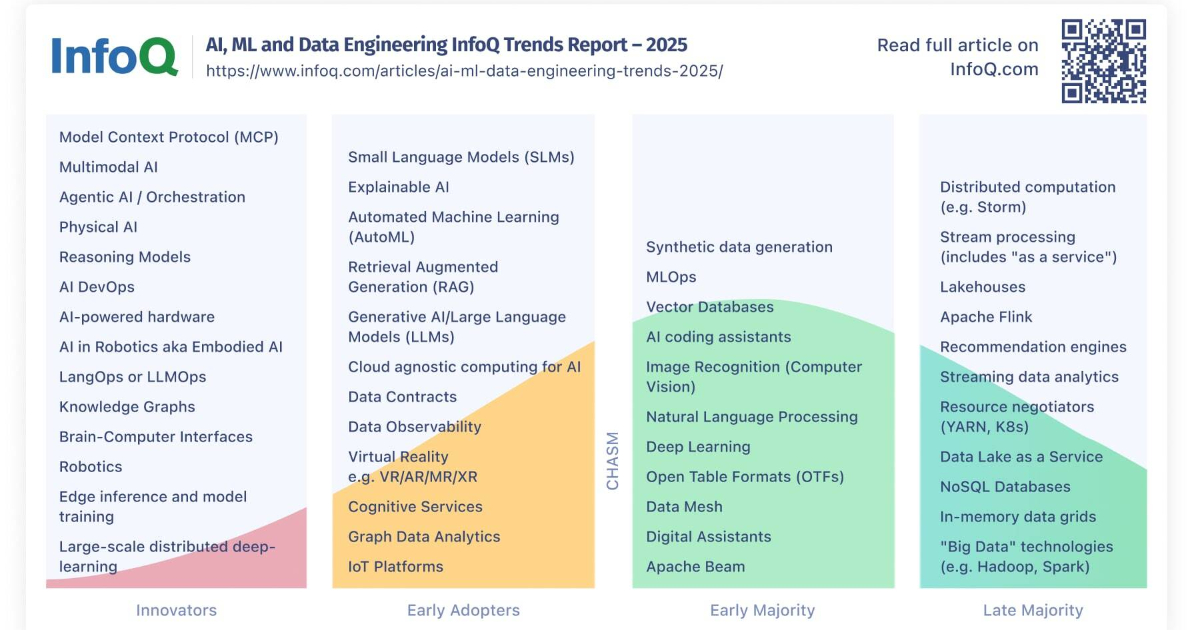
InfoQ’s 2025 report discusses physical AI, software co-creation, AI-assisted delivery and interoperability protocols including MCP and A2A. These are observations from that edition; they do not prove that an agent is dependable in a particular business workflow.
Read the original InfoQ report for the source authors’ full discussion. The following implementation review is TensorBlue’s analysis, revised in October 2026; it is not a reproduction of that report.
Evaluate the action chain, not just the answer
A drafting assistant produces text; an agent connected to tools can change systems. Before adding tool access, map each proposed action to its authorized user, inputs, side effects and review requirements. Use a read-only starting workflow when it can establish value. Measure whether the system completes the intended task, including recovery from missing information and failed dependencies.
Treat protocol compatibility as one integration check
A common protocol can simplify connecting systems, but it does not make every tool suitable for every agent. Review authentication, argument schemas, error handling, permissions and version compatibility. Test the actual client and server combination. Document how credentials are scoped and how access can be revoked without disrupting unrelated users.
Keep software co-creation reviewable
For a hypothetical coding workflow, require the generated change to pass the project’s existing checks and receive appropriate review. Separate producing a patch from approving or deploying it. Record the request, relevant repository state, changed files and verification results. Track regressions and review effort as well as generation speed so that an apparently faster workflow does not merely shift work to maintainers.
Measure context quality independently
An agent’s output depends on the documents, tool results and repository information it receives. Include missing, outdated and contradictory context in evaluation. Check whether the agent acknowledges unavailable evidence and stops before an unauthorized action. A long context window is not a substitute for accurate selection, permission checks and clear task boundaries.
Translate physical AI into an operating environment
A physical workflow introduces sensors, timing, actuation and recovery constraints beyond a text interface. Define the environment and the human override before planning automation. Test observation errors and unavailable sensors with an approved simulation or bounded pilot. Avoid carrying a language-model benchmark into a claim about physical-system reliability.
Define an adoption gate
Agree on task completion, unacceptable actions, review workload, cost and recovery criteria before rollout. Keep a prior version or manual process available, and assign responsibility for incidents and access changes. The implementation recommendations here are our analysis, not reported customer outcomes. Use the 2024 review for the earlier model-and-retrieval questions that still underpin these workflows.
Compare the other annual review, explore our technology selection guide, or discuss a scoped implementation.